Blush Nowhere Near Your Cheeks and Liner That Goes Rogue: Inside the Glorious Mess of 'Weird Girl' Makeup
Somewhere between the ten-step skincare routines and the contour tutorials that required a protractor and a prayer, a generation quietly snapped. Not dramatically — no one threw their beauty blender out a window (probably). It was more of a collective shrug, followed by someone deliberately smearing teal eyeshadow across their nose bridge and posting it to TikTok with the caption: "idk I thought it looked cool."
And thus, weird girl makeup was born. Or rather, acknowledged. Because the truth is, the chaotic beauty impulse has always existed — it just spent a long time being told to sit down, blend out, and look more "natural."
What Even Is Weird Girl Makeup?
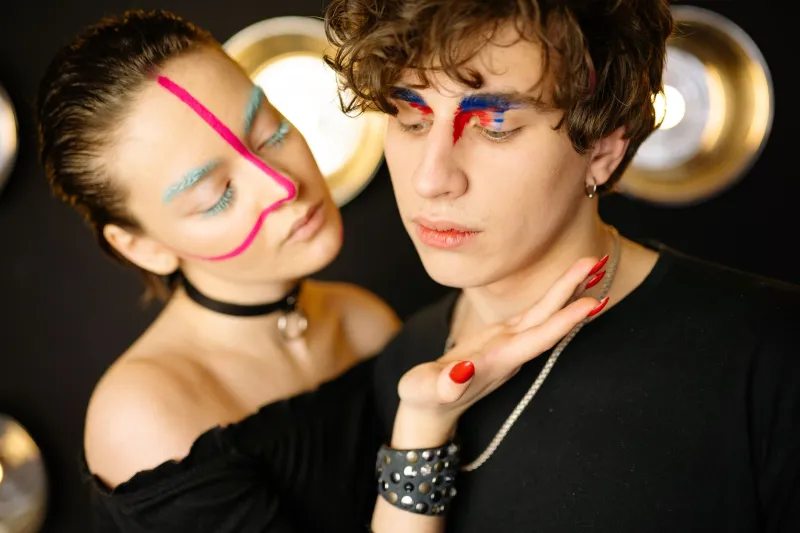
If you've spent more than twelve minutes on TikTok's beauty side lately, you've seen it: graphic liner that goes places liner has no business going. Eyeshadow in colors that feel like they were selected by a toddler having the time of their life. Blush applied to eyelids, foreheads, the tip of the nose. Lipstick that stops mid-lip on purpose. Mismatched eye looks. Rhinestones glued in asymmetric clusters. Mascara smudged downward, intentionally, like you've been crying at a really good concert and decided to lean into it.
The aesthetic resists a single clean definition — and that's kind of the whole point. It's surrealist. It's playful. It borrows from editorial fashion shoots, anime, theater makeup, and the unsupervised art projects of elementary school. The common thread isn't a specific look. It's an attitude: this face is a canvas, and I'm the artist, and I didn't go to art school, and I don't care.
The Algorithm Made Us Do It (And Then We Fought Back)
To understand why weird girl makeup feels so radical, you have to understand what it's rebelling against.
For the better part of a decade, Instagram beauty set the standard. Filters, ring lights, and an endless feedback loop of engagement metrics quietly converged on one face: flawlessly contoured, highlighted within an inch of its life, perfectly symmetrical, and deeply, deeply beige. The algorithm rewarded the polished. The aspirational. The approachable-but-unattainable.
The result? A homogenization so thorough that beauty editors started writing think pieces about how everyone looked the same. Which, honestly, they did.
TikTok changed the equation — not because it's a morally superior platform (it absolutely is not), but because its algorithm rewards engagement, and nothing is more engaging than something genuinely surprising. A perfectly blended smoky eye? Cute. A look where someone has drawn a tiny sun on their chin and used three colors of liner that don't match? That's a comment section waiting to happen.
Creators like @glitchedbeauty, @paintmyface.weird, and a rotating cast of art-school dropouts-turned-makeup-philosophers have amassed millions of followers doing exactly that — making faces that make people stop mid-scroll and go, "wait, what?"
The Psychology of Looking 'Wrong' on Purpose
Makeup artists who work in editorial and avant-garde spaces will tell you that there's nothing new about unconventional beauty — Alexander McQueen's runway looks were practically surrealist performance art, and the downtown New York scene has always had its freaks (meant with full affection). What's different now is access and intention.
"There's something really freeing about making a choice that you know some people will think looks bad," says one independent makeup artist based in Brooklyn who asked to be identified only as Marcelline. "When you commit to something weird, you're signaling that you don't need external validation for your face. That's actually a really hard thing to do."
Psychologists who study self-presentation have long noted that nonconformist aesthetic choices serve as social signals — they communicate group membership, values, and sometimes a deliberate rejection of mainstream norms. Weird girl makeup, in this framework, isn't just about looking different. It's a statement about who you trust to define beauty standards. (Spoiler: not the algorithm.)
There's also something quietly radical about reclaiming the word "ugly." Many creators in this space explicitly describe their looks as ugly — not as self-deprecation, but as a reframing. If you call it ugly first, and you love it anyway, you've defused the insult entirely. That's a kind of aesthetic judo that would make a philosopher moderately proud.
Chaos Has a Skill Level (And It's Higher Than You Think)
Here's where it gets interesting: weird girl makeup is genuinely hard to do well.
This surprises people who assume that "not blending" means "not trying." But intentional chaos requires you to understand the rules well enough to break them interestingly. Slapping random colors on your face without thought just looks like you got into a fight with your makeup bag. The good stuff — the looks that feel electric and strange and somehow right — involves deliberate choices about placement, color theory, texture, and proportion.
"You have to know where blush should go to make it interesting that it's on your forehead," Marcelline explains. "The weirdness has to be in conversation with the conventional. Otherwise it's just noise."
This is why so many of the creators leading this movement have serious makeup chops. They're not skipping the tutorials — they graduated from them.
Why This Matters Beyond the Beauty Aisle
Weird girl makeup exists in a broader cultural moment where perfectionism is increasingly being called out as a mental health villain. The "that girl" aesthetic — 5 a.m. workouts, color-coded planners, green juice — has faced its own backlash. So has hustle culture. So has the idea that your worth is measured by your output, your optimization, your polish.
Showing up with mismatched eyeshadow and a rhinestone on your chin is, in its own small way, an act of refusal. It says: I am not here to be optimized. I am here to be interesting. I am here to have fun with the face I woke up with.
And in a media landscape that can feel relentlessly curated and exhausting, that's genuinely refreshing. Even if the blush is on the nose. Especially if the blush is on the nose.
So next time you're watching a 47-second TikTok of someone applying electric blue liner to their lower lip and nowhere else, resist the urge to ask "but does it look good?" Ask instead: does it look alive?
Because that, it turns out, is the better question.